
- Article Index
- About Us
- Contact
- Language/Idioma
-

-

The Rule of Thirds:
Another photographic rule? Or is there something more to it?
This is the first in a number of composition based articles centred on how you frame your subject or compose your image before pressing the shutter. Before kicking off, I would like to state that, on a personal level, I am not massively fond of being restricted by rigid photographic rules. I believe they are there to be broken, but this particular rule, the Rule of Thirds, is something I would adhere to a great deal when shooting in landscape orientation. Like any rule, it is best if you understand the concept and understand why and where it should be applied. You will then be in a better position to determine when it shouldn’t be applied making your rule-breaking photos more dynamic.
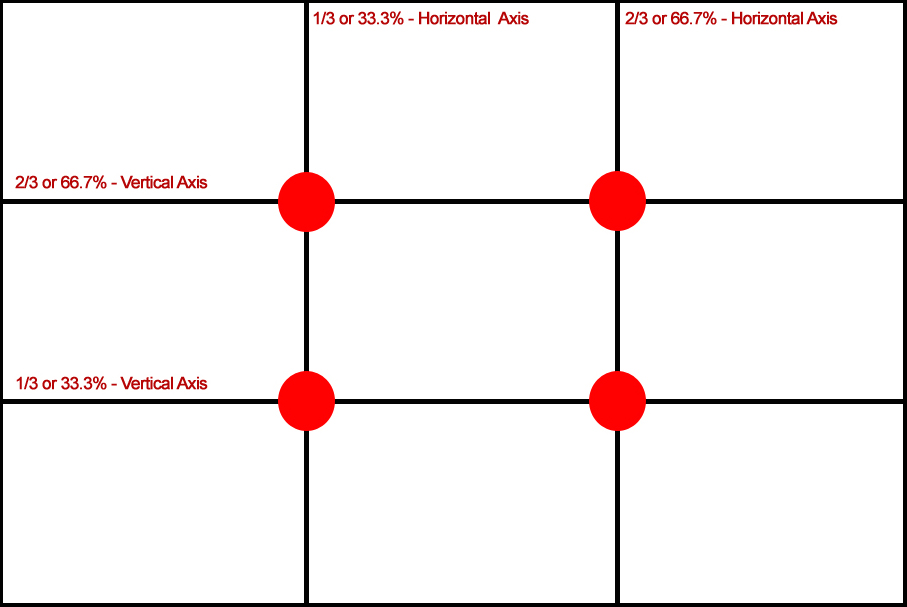 Most
people when starting out taking pictures have an automatic impulse to centre
their subject in the bull’s-eye position within the frame, in other words, dead centre,
top and bottom. Although the centre focus point on a DSLR might be the best, it is
unfortunately not the best place to position your subject if you want to add dimension,
depth and a sense of direction to the image. According to photographic theory, if you
break your frame down into 9 individual sections using a grid as shown in the photo to
the right you will end up with 4 clear points commonly called power points on the grid
where horizontal and vertical lines intersect. These horizontal and vertical lines divide
the horizontal and vertical axes of the frame into 1/3 segments. In percentage terms it
is 33.3% and 66.7%. So, as the theory goes, positioning your subject on one of these
intersection points or along one of the grid lines makes images appear more balanced and
will draw the eye of the viewer more easily to the important aspects of the image. This
isn’t mumbo jumbo, it does actually work.
Most
people when starting out taking pictures have an automatic impulse to centre
their subject in the bull’s-eye position within the frame, in other words, dead centre,
top and bottom. Although the centre focus point on a DSLR might be the best, it is
unfortunately not the best place to position your subject if you want to add dimension,
depth and a sense of direction to the image. According to photographic theory, if you
break your frame down into 9 individual sections using a grid as shown in the photo to
the right you will end up with 4 clear points commonly called power points on the grid
where horizontal and vertical lines intersect. These horizontal and vertical lines divide
the horizontal and vertical axes of the frame into 1/3 segments. In percentage terms it
is 33.3% and 66.7%. So, as the theory goes, positioning your subject on one of these
intersection points or along one of the grid lines makes images appear more balanced and
will draw the eye of the viewer more easily to the important aspects of the image. This
isn’t mumbo jumbo, it does actually work.
 Before
we go any further, let us take a look at the rule of thirds and how the ratios
themselves may be part of a bigger universal ratio.
The concept of rule of thirds could be considered a simplified version of what is called
the Golden Mean. This Golden Mean, or Divine Proportion, or Phi, whatever you prefer to
call it is a recurring ratio in nature that repeats itself regularly across the most obscure
of places. From cellular growth to the way rabbits breed it is associated with every living
thing found in nature. It is mathematically known as the Fibonacci Sequence where each
succeeding number in the sequence is the sum of the previous two numbers. So the sequence
would be along the lines of 1, 1, 2, 3, 5, 8, 13, 21 etc. As the sequence
continues, the ratio of succeeding numbers starts to approach the golden ratio. Fans of the movie & book
The Da Vinci Code would be familiar with the concept. It is also claimed that
the golden ratio is used to size everyday items like widescreen televisions,
postcards and even photographs. Take a look at the image to the right. In black
you have what is known as the Fibonacci Spiral. I have then overlapped the
Before
we go any further, let us take a look at the rule of thirds and how the ratios
themselves may be part of a bigger universal ratio.
The concept of rule of thirds could be considered a simplified version of what is called
the Golden Mean. This Golden Mean, or Divine Proportion, or Phi, whatever you prefer to
call it is a recurring ratio in nature that repeats itself regularly across the most obscure
of places. From cellular growth to the way rabbits breed it is associated with every living
thing found in nature. It is mathematically known as the Fibonacci Sequence where each
succeeding number in the sequence is the sum of the previous two numbers. So the sequence
would be along the lines of 1, 1, 2, 3, 5, 8, 13, 21 etc. As the sequence
continues, the ratio of succeeding numbers starts to approach the golden ratio. Fans of the movie & book
The Da Vinci Code would be familiar with the concept. It is also claimed that
the golden ratio is used to size everyday items like widescreen televisions,
postcards and even photographs. Take a look at the image to the right. In black
you have what is known as the Fibonacci Spiral. I have then overlapped the
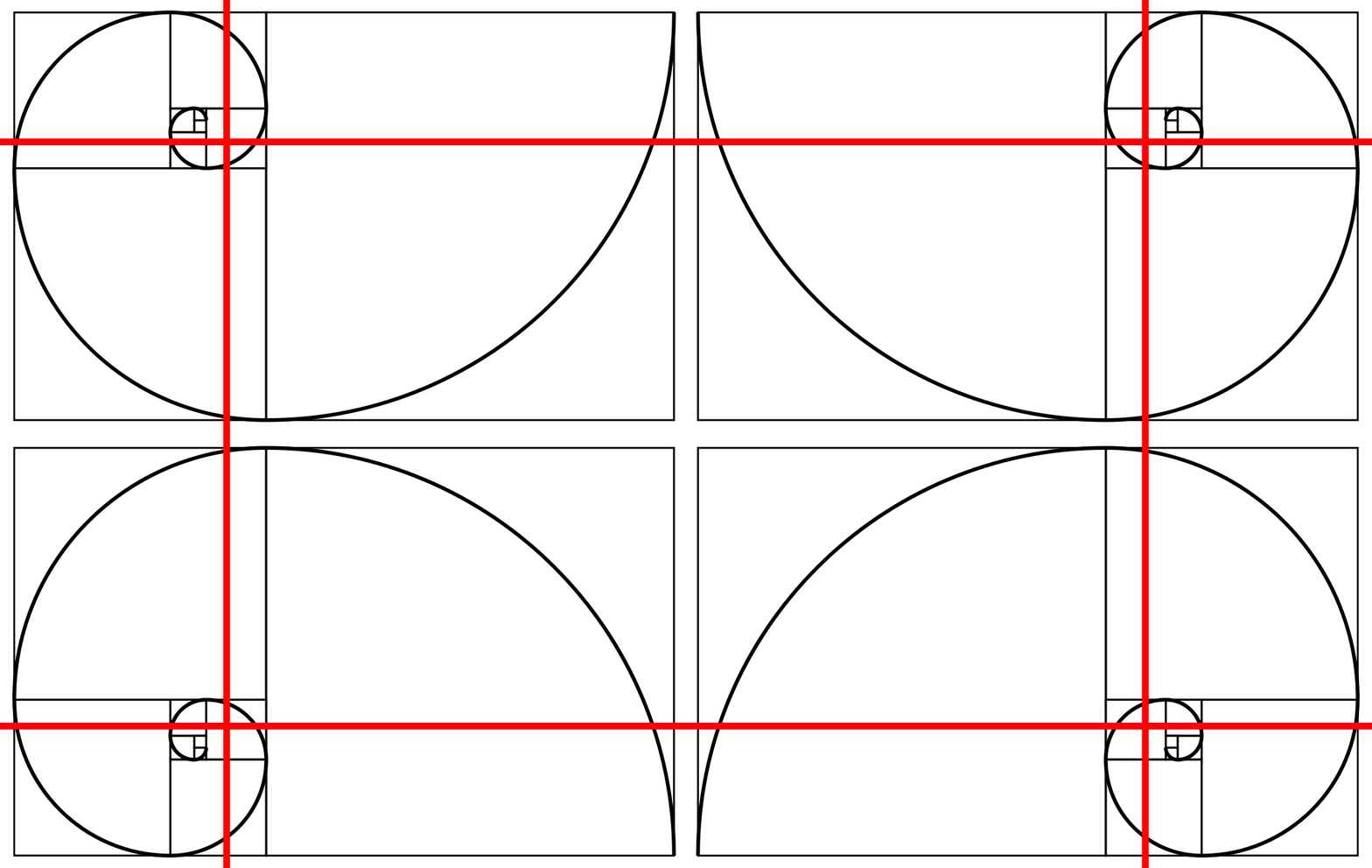 spiral with red lines that adhere to the Rule of Thirds. It approximates pretty closely!
This might all sound very complicated and we are possibly going off on a tangent but the
point I am trying to make is that the more simplified rule of thirds can be
closely approximated to this divine and universal ratio. It is not just isolated to the photographic world. It is nature’s way of numbering things
and it applies to every living thing. Our brains are wired to perceive things to be
“prettier” when their ratios are in thirds (accurately speaking you would say when their
ratios adhere to the Divine Ratio but for the purpose of this article we will keep the
context based on the simplified Rule of Thirds). Leonardo da Vinci’s Vitruvian Man (see
insert photo), limb proportions, butterfly wing patterns, facial dimensions, all of these adhere
spiral with red lines that adhere to the Rule of Thirds. It approximates pretty closely!
This might all sound very complicated and we are possibly going off on a tangent but the
point I am trying to make is that the more simplified rule of thirds can be
closely approximated to this divine and universal ratio. It is not just isolated to the photographic world. It is nature’s way of numbering things
and it applies to every living thing. Our brains are wired to perceive things to be
“prettier” when their ratios are in thirds (accurately speaking you would say when their
ratios adhere to the Divine Ratio but for the purpose of this article we will keep the
context based on the simplified Rule of Thirds). Leonardo da Vinci’s Vitruvian Man (see
insert photo), limb proportions, butterfly wing patterns, facial dimensions, all of these adhere
 loosely to the rule of thirds and almost identically to the divine proportion. You can
even take the concept to the stock market where 33.3% and 66.7% retracements known as
Fibonacci retracements are commonly used by technical analysts. If a stock price pulls
back by 33.3% or 66.7% and other technical indicators are positive then the stock price
can be perceived to be at a technical bottom. So as you can see, the Rule of Thirds is not
some rule conjured up by a team of photographers many moons ago, it is actually loosely
based on our biochemical make up along with every other living creature out there. We are
programmed to perceive things to be more pleasant when they adhere to the Rule of Thirds.
loosely to the rule of thirds and almost identically to the divine proportion. You can
even take the concept to the stock market where 33.3% and 66.7% retracements known as
Fibonacci retracements are commonly used by technical analysts. If a stock price pulls
back by 33.3% or 66.7% and other technical indicators are positive then the stock price
can be perceived to be at a technical bottom. So as you can see, the Rule of Thirds is not
some rule conjured up by a team of photographers many moons ago, it is actually loosely
based on our biochemical make up along with every other living creature out there. We are
programmed to perceive things to be more pleasant when they adhere to the Rule of Thirds.
So how do you put the rule of thirds into practice? The aim is to visualise the grid shown in the photo above and frame your image around this grid. The important elements of your composition should then ideally fall on the intersection points or if not then they should lie along the horizontal or vertical lines defining the grid. If the subject is a living thing then the general opinion is that your subject is facing into the frame as opposed to facing out. It gives the image a sense of direction when subjects are facing into the frame. See some examples of photos below that obey the rule of thirds.
As regards composing your image along the intersection points, there are two difficult parts to this. The first is visualising the grid in your viewfinder or LCD display. Some cameras have a grid that can be selected to appear in the viewfinder or in your LCD, but a lot don’t. You have to know where the intersection points are and this is simply learned by practicing. The second difficult job is the autofocus. A lot of cameras will not have autofocus points on the intersection points, so you will not be able to compose your image directly. Instead, for a large number of DSLR users you will need to use your focus lock function such that you lock focus using the centre autofocus sensor (for example). You can then recompose your image according to the Rule of Thirds and click the shutter. Providing you have not altered your distance from your subject your focus should be correct. Pro and Semi-Pro DSLR’s will have autofocus points along the intersection points but using them is not always best as these points tend to be less accurate than the autofocus points along the horizontal and vertical axes to the centre autofocus point. It’s just a case of finding what works for you. If you are using a simple point-and-shoot or phone camera then none of the above will apply as focus is usually determined across the entire frame. So in this case you can simply compose your image and click the shutter. Voila, photo taken and the Rule of Thirds is obeyed.
As mentioned earlier, when photographing living things, it is always deemed best to position them along either vertical line but also have the subject look into the frame as opposed to facing out. By doing this, the viewer will feel the enhanced sense of direction because of the way in which the subject is facing. In terms of landscape shots, it is perceived best when the horizon is on one of the horizontal lines and any points of interest within the composition are placed on the intersection points. If you want to emphasise the sky then place the horizon on the bottom horizontal for example.
 Also,
it is important to mention that all is not lost if you have taken a good shot yet your
subject is not positioned correctly. Almost any photo editing software will allow you crop your
image such that it becomes more balanced obeying the Rule of Thirds. That said, it is always
best to get the composition correct in camera as it means less time spent on front of a computer
after the shoot and you get maximum resolution from your images without having to cut parts out
of it – bigger print sizes!
Also,
it is important to mention that all is not lost if you have taken a good shot yet your
subject is not positioned correctly. Almost any photo editing software will allow you crop your
image such that it becomes more balanced obeying the Rule of Thirds. That said, it is always
best to get the composition correct in camera as it means less time spent on front of a computer
after the shoot and you get maximum resolution from your images without having to cut parts out
of it – bigger print sizes!
As I said at the beginning of the article, I don’t like to stick religiously to photographic
rules. They are there as a guide only and can be broken if the need is there. Every photo will
 have its own requirements, not all need to obey the Rule of Thirds. Is the photo an architectural
shot that needs symmetry to show its scale? Is it a portrait to hang on a wall in big print? Is
there an element in the frame that breaks the symmetry if the subject is centred? Do you want to
make your subject more intimidating? All of these and more need to be considered. If you as the
photographer believe the composition is better centred, then centre it. Don’t think that because
a photo does not obey the rule of thirds that it is of poorer quality and less balanced. Photography
after all is subjective. But if you do follow the rule of thirds, what it will do is make you
question your composition. It will force you to push yourself to frame a shot differently. But above
all it will make you look for the important points in your composition, make you ask yourself why
they are important and then push you to frame them emphasising their importance.
have its own requirements, not all need to obey the Rule of Thirds. Is the photo an architectural
shot that needs symmetry to show its scale? Is it a portrait to hang on a wall in big print? Is
there an element in the frame that breaks the symmetry if the subject is centred? Do you want to
make your subject more intimidating? All of these and more need to be considered. If you as the
photographer believe the composition is better centred, then centre it. Don’t think that because
a photo does not obey the rule of thirds that it is of poorer quality and less balanced. Photography
after all is subjective. But if you do follow the rule of thirds, what it will do is make you
question your composition. It will force you to push yourself to frame a shot differently. But above
all it will make you look for the important points in your composition, make you ask yourself why
they are important and then push you to frame them emphasising their importance.
If you like this article or others on the site then check out and “like” our Facebook page and you will get details of new articles posted straight to your newsfeed as soon as they are posted on our site. You can also find us on Google and Twitter. Author: Imagen Estilo
Testimonials
 Recently I had the pleasure of shooting with David and Sonia, I found them both to be very talented and professional to the nth degree. The images from our shoot are just fabulous! Lynne K
The whole family are completely blown away. The quality of the images are just amazing. Thank you so so much. C and F
Contact
+34-677-695-450
 +353-86-8370321
Email: info@imagen-estilo.com


Imagen-Estilo ©
All Rights Reserved
Design by: David Cummins
Going Shopping? Check out our recommended "Resource Guide"